The accident happened fast. Now your phone is full of opinions. Your neighbor says the damage looks fine and you can probably skip the repair. The insurance adjuster’s voicemail points you toward a shop across town. A YouTube video promises you can pop that dent out yourself with a hair dryer and a plunger.
Most of that advice is wrong. Some of it is expensive to believe.
Collision repair myths are everywhere, and they cost Tri-Cities drivers real money every year. Not just in repair bills, but in rust that spreads, warranties that get voided, safety systems that stop working, and resale value that quietly disappears. The wrong decision made in the first 48 hours after an accident can follow a vehicle for years.
We’ve been repairing cars in the Tri-Cities since 1981. We’ve seen what happens when drivers act on bad information. This guide corrects the six myths we hear most often, honestly, including the cases where the conventional wisdom is partly right.
What you’ll learn in this guide:
- Whether your insurance company can actually tell you where to take your car
- Why small dents and scratches aren’t always safe to ignore
- What OEM parts are and why the difference from aftermarket matters
- Why the first estimate is rarely the final number, and what that means for you
- How certified collision repair can restore a vehicle to factory condition
- Why DIY collision repair is riskier than it looks on a screen
Myth 1: Your Insurance Company Gets to Choose Your Shop

This is the collision repair myth that costs Tri-Cities drivers the most, because it shapes every decision that follows. A lot of people assume the insurance company runs the process. They don’t.
What Washington State Law Actually Says
Under Washington State law (WAC 284-30-390), it is defined as an unfair act for an insurer to fail to communicate in good faith with the repair facility chosen by the claimant. The regulation also prohibits an insurer from arbitrarily denying a claimant’s estimate for repairs at their chosen shop. That’s your legal protection, in plain terms: you pick the shop, and your insurer has to work with it.
Your insurance company may recommend shops through what’s called a Direct Repair Program, or DRP. These are shops that have volume agreements with the insurer, which makes claims processing faster and easier for the insurance company. That’s the reason for the recommendation. It’s not a quality rating.
What This Means for You
Preferred shops aren’t automatically bad. Some do good work. The point is that the choice belongs to you, not your adjuster. You have the right to take your vehicle to any licensed shop you trust, and your claim cannot be denied simply because you didn’t use the insurer’s preferred facility.
At Mathews Auto Body, we work with all insurance companies and handle the coordination process for our customers. Family-owned since 1981, we’ve navigated thousands of claims on behalf of Tri-Cities drivers. Stop by either location for a free walk-in estimate, no appointment needed, and we’ll take it from there.
Myth 2: Small Dents and Scratches Can Wait
Delaying a minor repair feels like a reasonable call. The car still drives. The damage looks cosmetic. Why spend the money now?
What’s Actually Happening Under the Surface
A scratch that breaks through the paint exposes bare metal to moisture. Rust doesn’t wait. It spreads under the surrounding paint, often invisibly, until what started as a small repair becomes a panel replacement. What looks like a surface scratch can also hide primer exposure, paint layer separation, or micro-cracks in plastic bumper components that reduce their ability to absorb a secondary impact.
The damage you can see is not always the full picture.
When Waiting Is Actually Fine
There’s an honest exception here. Purely cosmetic damage on an older, high-mileage vehicle may not be worth the repair cost. A small paint chip on a 2009 pickup with 180,000 miles is a different conversation than the same chip on a newer vehicle you plan to keep or sell.
The right way to find out which situation you’re in isn’t a guess in the driveway. It’s a free walk-in estimate from a certified technician who can tell you exactly what you’re looking at. No pressure, no appointment, just an honest assessment.
Myth 3: Aftermarket Parts Are Just as Good, and OEM Parts Are a Scam
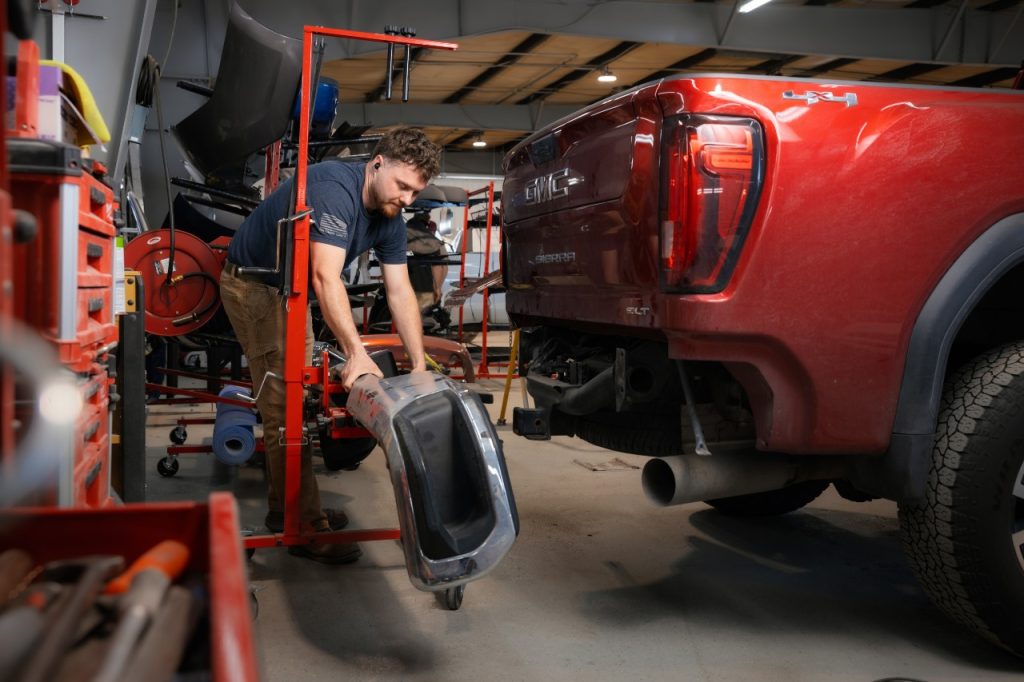
This one comes up constantly, and it’s understandable. Aftermarket parts are often less expensive, and the name sounds generic enough to seem equivalent. It usually isn’t.
What OEM Actually Means
OEM stands for Original Equipment Manufacturer. These are the exact same parts your car was built with at the factory, engineered to the manufacturer’s precise tolerances and tested to meet their crash-safety specifications. They fit the way the manufacturer intended because they’re made by the same source.
Aftermarket parts are produced by third-party manufacturers. Quality varies widely. Even small differences in fit, material, or construction can affect how body panels align, how safety sensors mount, and how structural components perform in a future collision. Those differences also show up in resale value, because a vehicle history report that notes non-OEM repairs raises questions for buyers.
Why Insurers Push Aftermarket
Insurance companies frequently request aftermarket parts to reduce claim costs. That’s their interest, not yours. You have the right to ask for OEM parts, and a quality shop will advocate for that with your adjuster.
The honest limit: for older vehicles where OEM parts are no longer available, or where the repair cost approaches the vehicle’s actual value, aftermarket may be the practical answer. A certified shop will tell you which situation you’re in, clearly, before any work begins.
Mathews uses OEM original parts on every repair, even when insurance calls for aftermarket. That’s not an upsell. It’s a shop standard we’ve held since 1981 because your safety isn’t something we cut corners on.
Myth 4: The First Estimate Covers Everything
Drivers often expect the initial estimate to be the final number. When the bill comes in higher, it feels like something went wrong. Usually, it didn’t.
How the Estimate Process Actually Works
The first estimate is built from visible damage. It’s what a technician can see before the vehicle is disassembled. Once the repair begins and panels come off, hidden damage to the frame, structural components, or safety systems is often discovered. That triggers what’s called a supplement, an updated claim submitted to the insurance company to cover the additional work.
This is normal. It’s not a sign of a dishonest shop. It’s how collision repair works on modern vehicles, which have complex structural systems that don’t reveal their full condition until a technician gets inside them.
What Separates a Good Shop from a Bad One Here
A reputable shop communicates every supplement clearly before any additional work proceeds. You should know what was found, why it needs to be repaired, and what it will cost before anyone picks up a tool. If a shop is adding charges without explanation, that’s a red flag.
At Mathews, disassembly and complete inspection is a dedicated stage in our repair process, specifically designed to find hidden damage before it becomes a surprise. We work directly with adjusters to document and explain every supplement, so our customers aren’t caught off guard.
Myth 5: A Repaired Car Is Never the Same Again

This myth does the most damage of all, because it stops drivers from getting proper repairs. The logic goes: once a car’s been in an accident, it’s permanently compromised, so why bother with a quality repair?
What Certified Collision Repair Actually Delivers
Modern collision repair, done correctly by certified technicians using OEM parts and manufacturer procedures, restores a vehicle to factory condition. That includes structural integrity, safety system performance, and finish. The goal isn’t to make it look right. It’s to make it perform the way the manufacturer built it to perform.
I-CAR Gold certification, which our technicians hold, is the highest level of collision repair training in the industry. It means our team is trained to repair modern vehicles to manufacturer specifications, not just to pass a visual inspection.
The Honest Part of This Myth
There is one thing a quality repair can’t change: a vehicle with significant structural damage history will show that on a Carfax report, regardless of how well it was repaired. Proper repairs protect safety and value. They don’t erase the accident from the record.
We think that’s worth saying plainly. Transparency is part of how we’ve kept customers coming back for over 40 years. Mathews is I-CAR Gold certified, OEM-certified for 12-plus manufacturers, and every repair we do is backed by a lifetime warranty.
Myth 6: You Can Handle Minor Collision Damage Yourself
DIY repair kits are easy to find, and the tutorials make the process look straightforward. For a narrow category of damage, they’re fine. For most collision damage, they’re not.
Why Modern Vehicles Change the Equation
Today’s vehicles are built with aluminum panels, high-strength steel, and integrated safety sensors throughout the body. These materials require specific tools and techniques. Improper handling weakens structural integrity in ways that aren’t visible until the next impact.
The bigger issue is ADAS, which stands for Advanced Driver Assistance Systems. These are the cameras, radar units, and proximity sensors that power features like automatic emergency braking, lane departure warning, and blind-spot monitoring. They’re mounted throughout the vehicle, and even a minor shift in panel alignment can throw off their calibration.
According to CCC Intelligent Solutions’ Q4 2025 Crash Course report, ADAS calibrations now appear on more than one in three repair estimates, up from roughly one in four just a year earlier. Enlyte’s 2026 Envision Trends report, drawing on Mitchell estimating data, found that share has nearly tripled since 2022. These sensors don’t self-correct after an impact. A sensor that looks undamaged and isn’t recalibrated can fail to activate when it’s needed most.
Where DIY Is Actually Reasonable

A true cosmetic scratch on a non-structural panel, touch-up paint on a small chip, these are reasonable DIY territory. Anything involving a dent, a bumper, a panel replacement, or any component near a sensor is not. The risk isn’t the repair cost. It’s what you can’t see and can’t test without the right equipment.
Our certified technicians use computerized frame measuring systems and perform ADAS calibration as a standard part of the repair process, not as an add-on.
What to Do After an Accident in the Tri-Cities
The pattern across all six of these collision repair myths is the same: the wrong assumption leads to a decision that costs more later, whether that’s rust spreading under a scratch you ignored, a safety sensor that wasn’t recalibrated, or a repair done with parts that don’t fit the way the factory intended. None of these outcomes are obvious in the moment. That’s what makes the myths stick.
The corrective action is the same in every case. Don’t guess. Don’t act on the first thing your adjuster says. Don’t let a YouTube tutorial make a structural repair look simpler than it is. Get an honest look from a certified technician who can tell you exactly what you’re dealing with.
After an accident in the Tri-Cities, the right first step is a free walk-in estimate, not a phone call to your insurance company, not a neighbor’s opinion, and not a driveway assessment. Mathews Auto Body has been serving Kennewick, Pasco, and the surrounding Tri-Cities community since 1981. We’re family-owned, I-CAR Gold certified, and we handle the insurance process so you don’t have to. Learn more about our collision repair services and what a factory-correct repair looks like.
Stop by either location for your free walk-in estimate, no appointment needed. We’re at 614 W Columbia Dr in Kennewick and 3203 W Marie St in Pasco. Mathews works with all insurance companies, and we’ll handle the process for you from the first estimate to the final inspection.