Your car is damaged. You’re shaken up. And now someone is telling you to call your insurance company, get an estimate, choose a shop, and figure out your deductible. All of it at once, right after an accident.
That’s a lot. And most drivers have never been through it before.
Here’s the honest truth: the auto body shop insurance claims process has a lot of moving parts, but a good shop handles most of them for you. You don’t have to become an expert in collision repair or insurance adjusters. You just need to know enough to make good decisions and find a shop you can trust to do the rest.
At Mathews Auto Body, we’ve been helping Tri-Cities families through this process since 1981. We work with all insurance companies, and we handle the back-and-forth so you don’t have to. This guide walks you through exactly what to expect, from the moment after the accident through the day you pick up your car.
In this post, you’ll learn:
- What to do in the first hours after an accident
- Your legal right to choose your own repair shop
- How estimates, supplements, and deductibles actually work
- Why OEM parts and ADAS calibration matter for your safety and your claim
Step 1: What to Do Right After the Accident

Before you think about shops or estimates, take care of the basics at the scene.
Call your insurance company to report the claim, or get the contact information for the at-fault driver’s insurance if they caused the accident. Document everything you can: photos of the damage to both vehicles, license plates, the location, and any visible road conditions. The more documentation you have, the smoother the claim process tends to go.
Get a claim number. Your insurance company will assign one when you report the accident. Write it down. You’ll need it when you contact a repair shop.
One thing you don’t have to do right now: choose a shop. You have time. Don’t let anyone pressure you into a decision at the scene or in the first phone call with your insurer.
Step 2: You Have the Right to Choose Your Own Shop
This is one of the most important things to understand about the collision repair insurance process, and most drivers don’t know it.
Your insurance company may recommend a list of “preferred” or “direct repair” shops. These are shops that have agreements with the insurance company to handle claims at high volume. That arrangement can be convenient, but it also means those shops are operating under pressure to move quickly and keep costs down.
You are not required to use any shop your insurance company recommends. Drivers have the legal right to choose any licensed repair facility, regardless of what the insurer suggests.
That distinction matters. A family-owned shop like Mathews isn’t beholden to insurance volume quotas. We’ve been doing this in the Tri-Cities since 1981, and every repair gets the attention it deserves, not the attention a quota allows.
Step 3: Getting Your Estimate

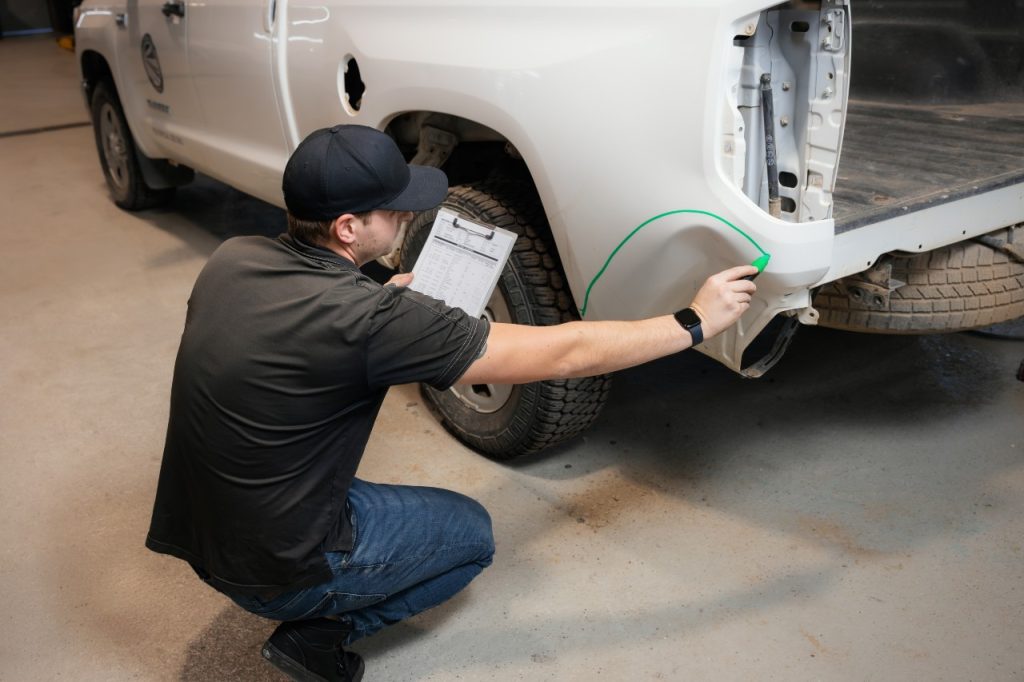
Once you’ve chosen Mathews, just walk in. No appointment needed at either location. We’ll do a thorough visual inspection and initial damage assessment, and we’ll run diagnostic scans where the damage warrants it.
One thing to set your expectations on early: the initial estimate covers the visible damage. Once a technician begins disassembly, hidden damage often surfaces. Bent supports, compromised wiring, structural concerns that weren’t visible from the outside. This is completely normal in collision repair, and it’s not a sign that something went wrong. It’s just the nature of how cars absorb impact.
We document everything thoroughly from the start, which supports your insurance claim and keeps the process moving.
Step 4: How We Work with Your Insurance Company
This is where a lot of the stress lives for most customers, and it’s also where we take the most off your plate.
We submit your estimate directly to the insurance adjuster. We handle the communication. When hidden damage is found during disassembly, we document it and submit what’s called a supplement, which is a request to the insurance company for approval to cover the additional repairs. Supplements are a normal, expected part of the collision repair insurance process. They’re not a red flag. They’re what happens when a shop is doing the job right instead of guessing at the full scope upfront.
We keep you informed at every step. If something changes, you’ll hear from us before work continues.
Step 5: Understanding Your Deductible
Your deductible is the amount you pay directly to the repair shop. Insurance covers the rest.
Here’s a simple example: if the total repair cost is $4,200 and your deductible is $500, your insurance company pays $3,700 and you pay $500 to us at pickup.
It’s worth knowing that the national average collision claim exceeds $5,000, according to the National Association of Insurance Commissioners, so most collision repairs do involve insurance coverage beyond the deductible.
For minor damage, it’s worth comparing the repair cost to your deductible before filing a claim. If the repair is less than your deductible, paying out of pocket may make more sense, since filing a claim can affect your premium.
Coverage type matters too. Damage from a collision with another vehicle or object typically falls under your collision coverage. Hail damage or damage from a falling object is usually covered under comprehensive coverage. If you’re not sure which applies, your insurance agent can clarify.
Step 6: OEM Parts and Why They Matter

Insurance companies sometimes push for aftermarket parts as a way to reduce the cost of a claim. It’s worth understanding what that actually means for your vehicle.
OEM parts, which stands for Original Equipment Manufacturer, are the exact same parts your car was built with at the factory. Aftermarket parts are generic alternatives made by third-party manufacturers. They vary in quality, fit, and how well they hold up over time.
At Mathews, we use OEM original parts on every repair. Your car was engineered with specific components for a reason, and using the right parts preserves the crash-test performance your vehicle was designed to deliver, protects your warranty coverage, and maintains your resale value.
You have the right to request OEM parts on your repair. We advocate for that on your behalf when working with your adjuster.
Step 7: ADAS Calibration and Your Modern Vehicle
If your vehicle was built in the last several years, it likely has cameras, radar sensors, or other driver-assistance technology built in. These systems, collectively called ADAS (Advanced Driver Assistance Systems), include features like automatic emergency braking, lane-keep assist, and blind-spot monitoring.
After structural or panel repairs, these sensors often need to be recalibrated to manufacturer specifications. According to Autobody News, ADAS calibration appears on approximately 35.6% of repair estimates, and diagnostic scans appear on approximately 87.7% of estimates. A sensor that’s even slightly out of alignment can disable or degrade the safety features your vehicle depends on.
Mathews verifies all sensor calibrations as part of our repair process. It’s something worth confirming with any shop you consider, because not every shop has the equipment or training to do it correctly.
Step 8: What Affects Your Repair Timeline
Timelines vary, and it’s worth knowing why before your car goes in.
Parts availability is one of the biggest factors, especially for newer or specialty vehicles. OEM parts sometimes take longer to source than aftermarket alternatives, but the fit and safety are worth it. Insurance approval speed matters too, particularly when supplements are involved, since work can’t continue on newly discovered damage until the insurer approves the additional scope.
The complexity of the repair plays a role as well. Structural repairs, frame straightening, and ADAS recalibration all take more time than a simple panel replacement. Shop backlog during peak seasons can also affect scheduling.
We communicate delays and changes as they happen. No surprises, no guessing.
The Right Auto Body Shop Makes the Process a Lot Easier
Filing an auto body insurance claim doesn’t have to be the stressful part of recovering from an accident. When you have a shop that knows the process, handles the adjuster communication, and keeps you informed, most of the complexity disappears.
Every repair at Mathews Auto Body is backed by a lifetime warranty on workmanship. We use OEM original parts, our technicians are I-CAR Gold certified, and we’re factory-approved by 12+ manufacturers. We’ve been a family-owned shop in the Tri-Cities since 1981, and we treat every car like it belongs to a neighbor, because it usually does.
Get Your Free Estimate at Mathews Auto Body
Stop by either location for a free walk-in estimate. No appointment needed.
Kennewick: 614 W Columbia Dr
Pasco: 3203 W Marie St
We work with all insurance companies and handle the process from estimate through final inspection. Walk in, and we’ll take it from there. Visit us our website to learn more about our locations and services.